
Newsroom
How a Tuberculosis Screening Project Survived Running Out of the Protein It Depended On
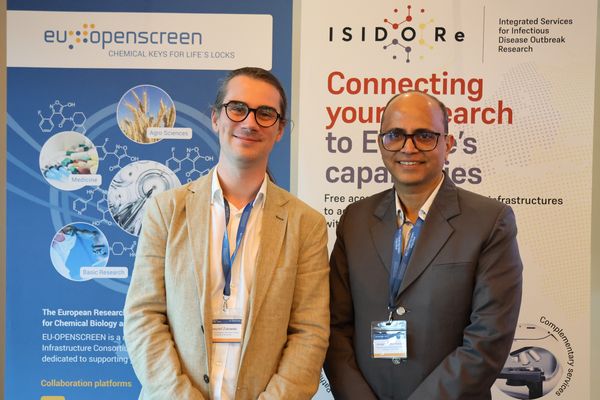
That was the risk facing Sandeep Ghorpade’s tuberculosis screening project. His team at the Holistic Drug Discovery and Development Centre in Cape Town had the target and the assays for a screen they could not run. The Institute of Bioorganic Chemistry of the Polish Academy of Sciences could.
The route to that screen opened in 2022, when Bahne Stechmann introduced EU-OPENSCREEN at the H3D symposium in Stellenbosch. Beyond the hits themselves, Sandeep Ghorpade saw a chance to put H3D scientists in front of high-throughput screening as a capability-strengthening exercise. EU-OPENSCREEN’s project managers guided the proposal through, then introduced the team to several partner sites with screening facilities and set up the conversations.
All of them had impressive infrastructure. What decided it was the enthusiasm and technical insight of Jacek Kolanowski, head of the Polish site, his team and the fact that IBCH’s budget and timelines matched H3D’s. The European Chemical Biology Library would be screened against the Mycobacterium tuberculosis ClpC1P1P2 complex in Poznań.
Tuberculosis treatment is long, and drug-resistant M. tuberculosis continues to outpace the drugs available. The need is for compounds that hit targets existing drugs do not, and that might shorten the course of treatment.
The caseinolytic protease complex is one such target. It maintains protein homeostasis by degrading damaged or misfolded proteins, and M. tuberculosis cannot grow or survive without it. Compounds that interfere with it can have rapid bactericidal activity, and those already in preclinical development have shown potential to shorten treatment. H3D in Cape Town, a member of the TB Drug Accelerator consortium, had built in vitro Clp enzyme assays and wanted to screen a large library against the complex.
“At H3D, we do not have access to a high-throughput screening facility and well-curated compound libraries,” says Sandeep Ghorpade. The team had long wanted to run this screen.
Running it took work at the Poznań end. “One of my main contributions was introducing several modifications to the experimental protocol, which allowed us to carry out the screening and obtain reliable, high-quality results,” says Krzysztof Żukowski. The pilot screen ran as planned. Then the project stalled, over a problem with protein supply. ClpC, one component of the complex, was needed in exceptionally high quantities, 600 mg of it. The supply could not be scaled up.
Each side took on part of the problem. Despite never having produced the protein in that quantity before, Dr Zaahida Sheik Ismail, an investigator at the Holistic Drug Discovery and Development Centre at the University of Cape Town produced the protein and shipped it to Poznań. By then IBCH’s screening capacity had been committed elsewhere and the project’s timelines had expired. Even so, timelines were extended, IBCH fitted the screen back into its schedule, and the main screen was completed. It produced confirmed hits, a subset of them prioritised for further profiling as starting points for new anti-TB drug discovery.
The results also took Żukowski further than the screen required, into how the structures of the active compounds related to the positive control, and whether anything was interfering with the signal in the assay. He describes the stretch that preceded them without complaint. “As in any scientific project, there were some unexpected situations and delays, whether related to reagents or equipment,” he says. “Nevertheless, the collaboration was always characterised by mutual understanding, patience and respect.”
“We sincerely appreciate the understanding and support from both EU-OPENSCREEN and IBCH-PSA in this situation, which led to the successful completion of the project,” says Sandeep Ghorpade.
Dr. Zaahida Sheik Ismail also travelled to Poznań and worked alongside Żukowski at the bench. “It gave me the opportunity to work alongside her in the lab, benefit directly from her expertise and discuss different aspects of the project,” he says. “It was also a great opportunity to get to know each other better on a personal level, which definitely helped strengthen our working relationship.”
The screen H3D had wanted for years has been run, and one of their scientists has been trained on a high-throughput platform that Cape Town does not have.
“I believe this collaboration would have been highly unlikely without the support of the EU-OPENSCREEN consortium,” says Żukowski. “If we were not part of this network, we might never have had the opportunity to meet the user and learn about their research project in the first place.”
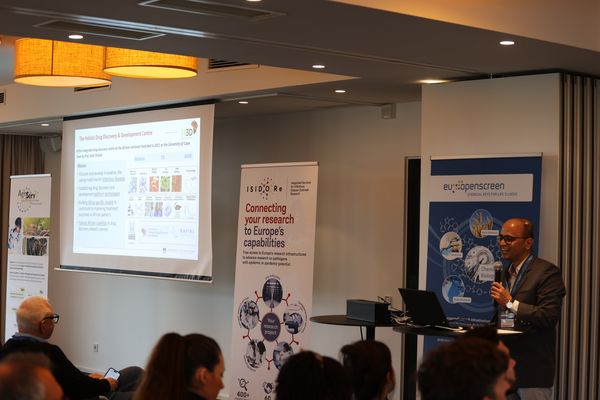
Sandeep Ghorpade and Krzysztof Zukowski presented “High-throughput screening of the European Chemical Biology Library to identify hits targeting Mycobacterium tuberculosis caseinolytic protease” at the EU-OPENSCREEN User Day 2026 in Berlin, in Session 1: Screening.