
Newsroom
How a Project on Drought Tolerance in Crops Expanded What a Screening Platform Could Offer
Drought is among the greatest causes of agricultural production losses worldwide, costing an estimated $37 billion a year. Agricultural scientists know which proteins govern how a plant responds to water stress. What they rarely have is the machinery to test hundreds of thousands of compounds against those proteins
Jorge Lozano-Juste’s group at the Institute for Plant Molecular and Cell Biology in Valencia set out to design small molecules that improve drought tolerance in crops. The biology was theirs. The high-throughput screening, compound libraries and drug discovery expertise were not. That search led him to EU-OPENSCREEN, and from there to the Innopharma platform coordinated by Professor Mabel Loza at the University of Santiago de Compostela.
The first meeting stayed with him.
“I will always remember our very first meeting, when I presented my research project to the team of the Innopharma platform. They were incredibly positive, enthusiastic, and willing to collaborate from the very beginning,” he says.
What followed was a target-based screening campaign at Innopharma, followed by iterative cycles of design-synthesis-test, that turned early hits into a best-in-class compound with the potential to regulate water use in agriculture. For Jorge Lozano-Juste, the collaboration “has considerably increased the scope and impact of our research”, and its impact is reflected in successful grant applications, publications and a patent.
The exchange was not one-sided. Screening platforms are built to handle whatever question a user arrives with, and this one arrived needing something the Santiago team had not tackled before. Working on it pushed them, as David Moreira Álvarez describes, to implement and standardise a new technology in their own laboratory: thermal shift assays, used to identify ligands that bind to and stabilise a target protein.
He also points to something simpler. Researchers from the Valencia group have come to Santiago and stayed, and those visits “have been both rewarding and stimulating, allowing us to gain experience together and devise solutions for the challenges that arose throughout the process”.
The collaboration continues, with the two groups now working to establish an in vitro high-throughput screening assay to identify small molecules that bind to another protein involved in drought adaptation. For the platform, as David Moreira Álvarez puts it, the partnership “serves as yet another successful example” of what becomes possible when a user and a laboratory are matched deliberately. For Jorge Lozano-Juste, that first meeting “opened the door to a long-lasting collaboration with EU-OPENSCREEN that has had a significant impact on both my research and my scientific career”.
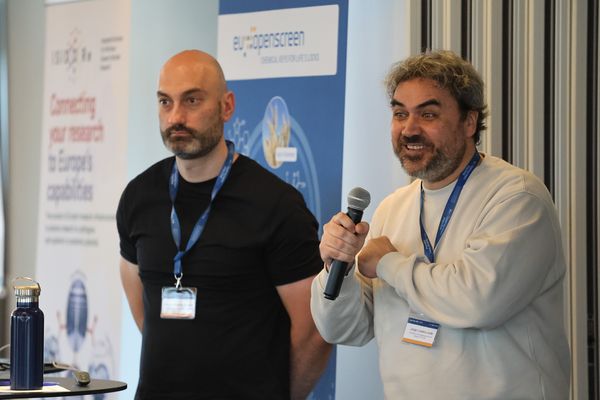
Jorge Lozano-Juste and David Moreira Álvarez presented “Drug discovery for thirsty crops” at the EU-OPENSCREEN User Day 2026 on 24th November 2026 in Berlin.